• Advances in Biocontrol & IPM 2019: Addressing the innovation crisis

    Over the last decade, the AAB’s conferences covering advances in biocontrol, IPM and biopesticides have become firm fixtures on the UK’s calendar of events. The overall objective has been to create an annual gathering of the UK IPM community at which policy makers, experienced researchers, young scientists and practitioners can detach themselves from their usual […]

  • Advances in Nematology 2019

    This conference has invited contributions from all areas of nematology (biology, ecology, epidemiology, management of plant parasitic nematodes, entomopathogenic nematodes and diagnostic methods). It actively invites students to participate, both in the platform presentations and the poster session. A prize is given for the best student platform presentation – Bryan Kerry Prize.

  • International Advances in Pesticide Application

    Over the last three decades the Pesticide Application Group has provided a forum for researchers from around the world to discuss progress with the development of pesticide application technology. During this time great advances have been made to improve the efficacy and safety of pesticides, resulting in lower doses of pesticides in the field, leading […]

  • Advances in Legume Science and Practice 2

    Visit Meeting Website This is the second Legumes conference organised by the AAB ‘Cropping And The Environment (CATE)’ specialist group. We will bring together delegates from a broad spectrum of disciplines to explore the role of legumes in sustainable agriculture, with an emphasis on ecosystem service. Importantly the event will have an international flavour as […]

  • #UKPlantSciPresents webinar series

    Virtual on Zoom

    The fourth season of the #UKPlantSciPresents webinar series ran from September 28th - December 7th 2021. The series promotes excellence in UK plant science and each webinar features two speakers who will talk for 25minutes allowing 10 minutes for delegate questions. They take place at 3pm BST or GMT (after October 2021). December 7th: Eirini […]

  • Crop production with reduced pesticide and fertiliser inputs to reduce carbon footprints

    Please visit event website. October 13th-14th 9am-1.30pm Virtual Meeting on Zoom. Due to changes in legislation the UK food production industry faces serious threats to its productivity and crop safety through the loss of key plant protection products. Moreover growers need to produce same yields from lower inputs to reduce carbon footprints to contribute to […]

  • Applied Biology and Climate change: AAB-COP26 webinar series.

    Virtual on Zoom

    The COP26 Climate Conference is hosted in Glasgow in November 2021 and is (another) critical moment for humanity to establish policies to combat the myriad threats posed by climate change. As a UK-based society the AAB will mark this important event by hosting a webinar series that looks at how applied biology is impacted by […]

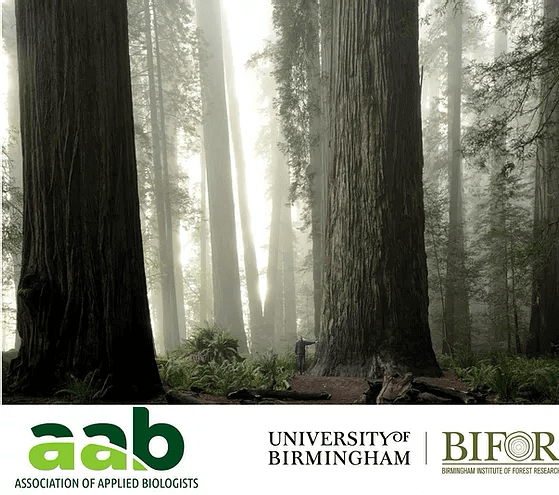
  • Trees for the Future Diversity and complexity for resilience and carbon storage

    Visit hybrid event website November 3-4 2021 As  a key part of actions to reach net zero carbon emissions by 2050, the  UK Government set a target of up to 19% woodland cover. Key decisions  therefore are required concerning how and where we expand tree cover.  Modern forestry is generally based on monocultures largely because […]

  • Thinking Differently about Soil-borne Disease Management

    Visit website for this Virtual event With increasing awareness of the importance of ‘soil health’ and pressure to reduce pesticide inputs and use alternatives, this conference aims to bring together a unique group with expertise in a range of disciplines to present and discuss ways to manage soil-borne diseases ‘outside of the current toolbox’. The […]

  • Improving Global and Local IPM

    Visit Event Website Over the last decade, the AAB “Advances in Biocontrol, IPM” Conference has become a popular fixture on our calendar of events. The overall objective has been to create an annual gathering of the IPM community at which policy makers, experienced researchers, early career scientists and practitioners can detach themselves from their usual […]